Recovering from arthroscopic hip surgery for femoroacetabular impingement (FAI) can feel like stepping into unfamiliar territory. You want to get back to moving without pain, but you also know that pushing too hard, too soon, could set you back. That’s why following a structured, phased rehabilitation protocol is critical. This guide walks you through the latest evidence-based recovery strategies, including weight-bearing timelines, mobility goals, and strength training considerations, while keeping your long-term wellness and fitness in mind.
We’ll cover what to expect week-by-week, why respecting healing timelines matters, and how to integrate functional strength, mobility, and cardiovascular conditioning into your comeback plan. Whether you’re an athlete, a fitness enthusiast, or simply someone who values an active lifestyle, you’ll find practical, actionable steps here to support your return to full function.
Understanding the Recovery Landscape for Fitness Enthusiasts
Arthroscopic surgery for FAI is designed to address bony impingement and repair or reconstruct the labrum. Post-operative rehab is not a one-size-fits-all process. Recent reviews highlight that while most protocols follow a similar phased structure, they must be adapted to individual factors, like the extent of the repair, your baseline fitness, and your personal goals. For example, a high-level soccer player with extensive labral damage may require a slower progression than a recreational runner with a minor repair, even if the surgical techniques were similar. Understanding that biological healing of cartilage and soft tissues can take 12, 16 weeks is key to setting realistic expectations and avoiding re-injury.
The key to successful recovery after hip arthroscopy for FAI is respecting biological healing timelines while ensuring progressive, criterion-based rehabilitation.
In 2024, studies reported return-to-sport rates of 75, 90% within 6, 12 months for those who followed structured protocols. This is a strong motivator to commit to the process and avoid shortcuts. Additionally, patient-reported outcomes show significant improvements in pain and function when rehab programs integrate both strength and mobility from the outset. For more on maintaining conditioning, see our cardiovascular health guide.
| Phase | Duration | Key Focus |
|---|---|---|
| Phase 1 | Weeks 0, 3 | Protection & Mobility |
| Phase 2 | Weeks 4, 8 | Early Strengthening |
| Phase 3 | Weeks 9, 16 | Advanced Strength & Control |
| Phase 4 | Weeks 16, 24+ | Return to Sport |
The structure in the table above provides a foundation, but every patient’s journey will be unique, influenced by prior injuries, movement habits, and overall conditioning.
Phase 1, Protection & Mobility for Fitness Recovery (Weeks 0, 3)
The initial weeks are all about protecting the surgical repair and allowing tissue healing. Your hip will be vulnerable, and overloading it could jeopardize your outcome. At this stage, the focus is on minimizing inflammation, protecting the labrum repair, and preventing secondary issues like muscle atrophy or joint stiffness. Adhering strictly to restrictions can feel limiting, but it ensures that the delicate surgical work has time to integrate.
- Weight-bearing: Partial weight-bearing with crutches, typically at 20, 30% of body weight.
- Mobility: Gentle passive range of motion, avoiding hip flexion beyond 90° and combined rotational extremes.
- Restrictions: No active hip flexion for the first 21 days.
- Pain Management: Cryotherapy and gentle soft tissue work on surrounding muscles.
Early overloading of the hip joint can compromise labral healing and lead to persistent symptoms, which is why controlled progression is vital.
According to sports physiotherapists, focusing on gentle gluteal activation and core stability at this stage helps lay the groundwork for later phases. Simple isometric exercises for the glutes, transverse abdominis engagement, and gentle ankle pumps can keep circulation active without stressing the hip. Monitoring swelling and pain levels daily can help guide safe progression toward Phase 2.
Phase 2, Early Strengthening to Support Fitness Goals (Weeks 4, 8)
Once cleared by your surgeon, you’ll progress to full weight-bearing. The emphasis shifts toward controlled strengthening without overloading the joint. This phase is critical for restoring muscle activation patterns that may have been disrupted by injury or surgery. By gradually increasing load, you’ll help the hip regain stability without risking irritation.
- Strength Work: Closed-chain exercises like bridges and mini-squats (above 90°) to activate glutes and quads.
- Joint Mobilization: Gentle hip mobilizations if there’s stiffness.
- Cardio: Low-impact options like stationary cycling.
- Precautions: Still avoid plyometrics, running, or deep flexion under load.
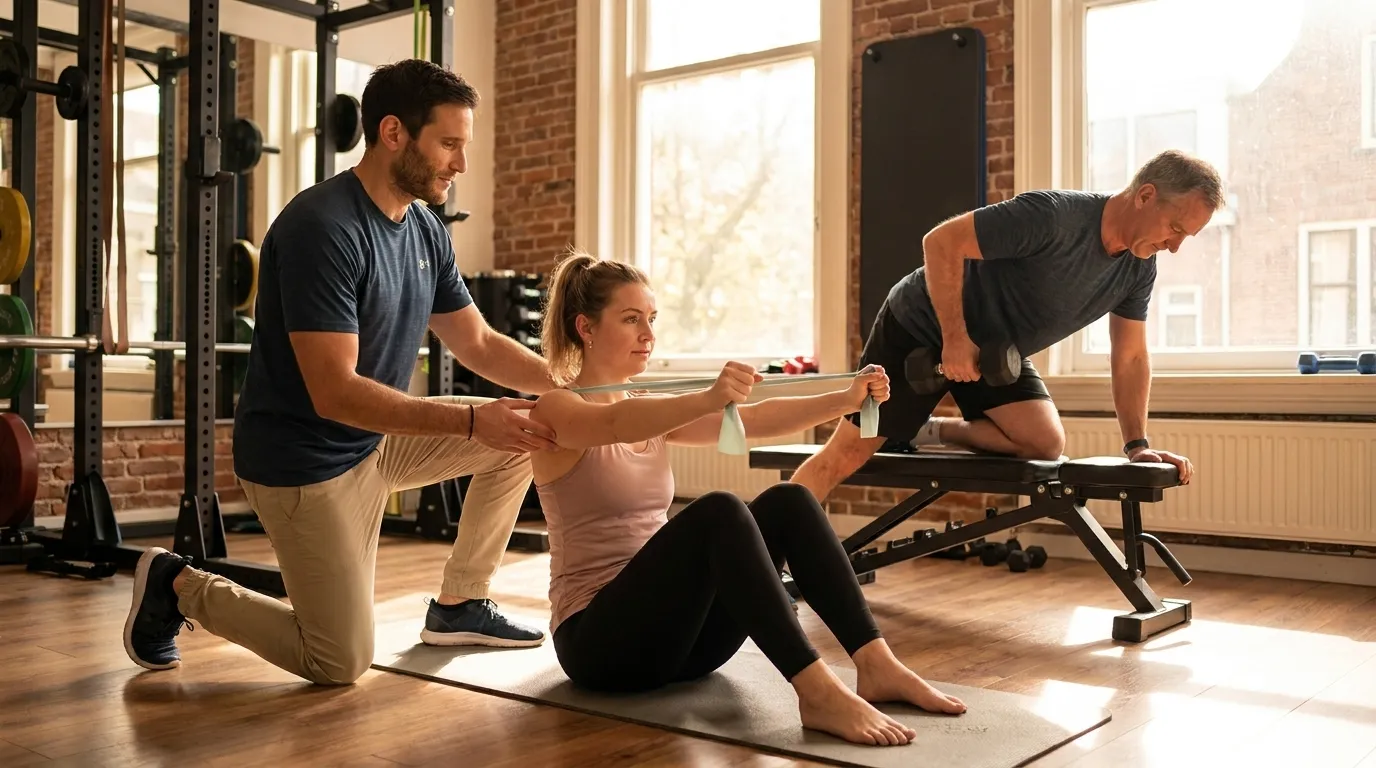
This is also when blood flow restriction (BFR) training can be introduced to maintain muscle mass with minimal joint stress. Tele-rehabilitation platforms are increasingly used to monitor form and progression remotely, allowing physiotherapists to fine-tune technique in real time. Incorporating resistance bands for lateral walks or clamshells can target hip abductors, which are often weak post-surgery. Remember, the goal is quality of movement, not quantity of reps.
If you’re looking to complement rehab with targeted strength work, our Strength and Conditioning Programs in Barcelona detail how to tailor training for recovery and performance.
Phase 3, Advanced Strengthening & Neuromuscular Control for Fitness Performance (Weeks 9, 16)
By this stage, your hip should tolerate more load, and the focus shifts toward restoring full function, stability, and sport readiness. You’ll be working on integrating the hip into more complex, multi-joint movements while ensuring symmetry between sides. This is where athletic performance elements start to reappear, but in a controlled, progressive way.
- Strength Training: Functional lifts, resisted hip rotations, and single-leg work.
- Neuromuscular Control: Balance drills, proprioceptive training, and controlled agility work.
- Cardio: Swimming, elliptical, or cycling to improve endurance.
- Sport-Specific Work: Gradual reintroduction under supervision.
Athletes benefit from integrating core and hip rotator control to avoid compensatory movement patterns, a key factor in preventing recurrence. For example, single-leg Romanian deadlifts can train both balance and posterior chain strength. Using unstable surfaces like balance pads can challenge proprioception and improve reaction time for sport.
| Outcome Measure | Average Improvement | Timeline |
|---|---|---|
| Hip Outcome Score | +25, 35 points | 6 months |
| Return-to-Sport Rate | 75, 90% | 6, 12 months |
| Revision Rate | <5% | 12 months |
These improvements are achievable when progression is systematic and guided by both time and functional milestones. Video analysis of movement patterns can help identify lingering asymmetries before they become problematic.
Phase 4, Return to Sport/Activity with Fitness Readiness (Weeks 16, 24+)
This phase is where plyometric and high-impact training returns, but only if you’ve achieved full pain-free range of motion, strength symmetry, and good neuromuscular control. It’s not just about physical readiness, mental confidence plays a huge role here. Athletes who feel secure in their movement are less likely to hold back or alter technique in ways that could cause new issues.
- Plyometrics: Box jumps, bounding, and multi-directional hops.
- Sport Simulation: Controlled scrimmages or movement patterns specific to your activity.
- Monitoring: Motion analysis tools can help detect subtle compensations before they lead to problems.
Athletes often combine this stage with advanced functional training. Sport-specific drills should mimic the unpredictable demands of competition, such as rapid changes in direction or reacting to an opponent’s movements. Recovery remains important; active recovery days with mobility work and light cardio help maintain joint health. For inspiration, see our Ultimate Guide to Advanced Functional Training Techniques.
Integrating Wellness, Longevity, and Fitness into Recovery
Rehabilitation isn’t just about returning to sport, it’s about setting the stage for long-term joint health. Nutrition, mental resilience, and balanced training all play a role in preventing re-injury. Adequate protein intake supports tissue repair, while anti-inflammatory foods like berries and fatty fish can help manage post-training soreness. Sleep quality is another overlooked factor; deep rest accelerates recovery by boosting hormonal balance.
- Wellness Practices: Yoga, Pilates, and mindfulness for mobility and stress reduction.
- Strength Training: Maintain a regular program to support joint stability.
- Cardiovascular Health: Gradually expand your cardio base for overall fitness.
Combining rehab with a broader wellness plan ensures you’re not only recovered but thriving. Consider periodic check-ins with your physiotherapist even after full return to sport to catch potential issues early. Long-term hip health is built on consistent movement quality, balanced strength, and lifestyle choices that reduce cumulative stress on the joint. You can also explore our nutrition for lasting fitness success to support your recovery.
Building Your Path Forward
Recovering from arthroscopic hip surgery for FAI requires patience, discipline, and a strategic plan. By respecting each phase’s purpose, from protection to full performance, you give your body the best chance to heal and adapt. This means embracing both the physical and mental aspects of rehab; staying motivated during slower phases can be just as important as pushing hard when you’re ready.
The most successful recoveries happen when you:
- Follow your surgeon and physiotherapist’s guidelines.
- Progress based on both time and functional readiness.
- Integrate strength, mobility, and cardiovascular work in balance.
- Stay consistent and committed.
Every phase is an investment in your future mobility, whether that’s for competitive sport, strength training, or simply living pain-free. Take the long view, trust the process, and your hip, and your whole body, will thank you. Remember, setbacks can happen, but with the right mindset and adjustments, they don’t have to derail your progress. Keep tracking your improvements and celebrate milestones along the way.
If you’re ready to optimize your recovery and fitness journey, explore our Body Composition Analysis for Personalized Fitness Success to fine-tune your training and nutrition alongside your rehab.