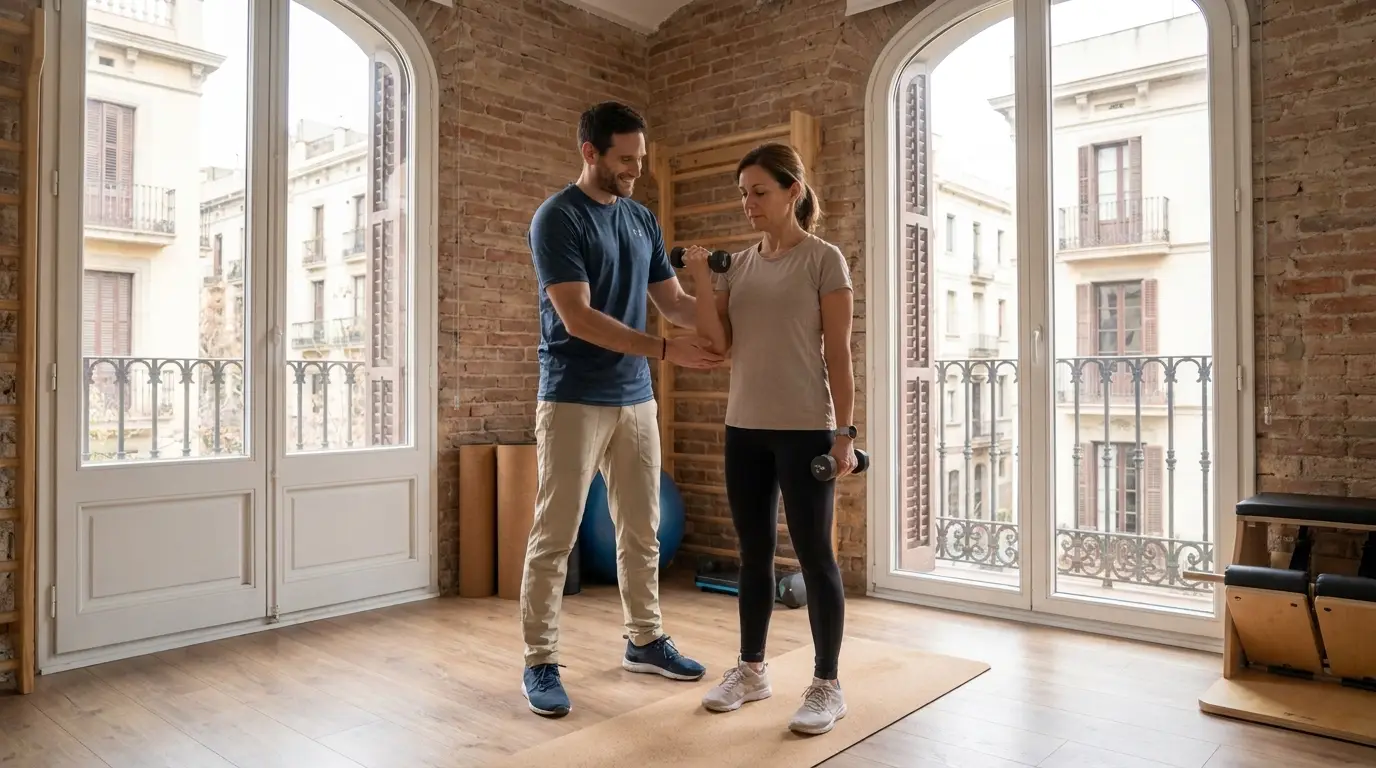
If you’re looking into personal training for beginners over 40 and living in Barcelona, getting started can feel harder than it should. Many English-speaking expats and international professionals in Sarrià-Sant Gervasi, Les Tres Torres, Pedralbes, and Eixample do not need more fitness content; they have usually seen plenty of that already. What they often need is a clear, safe way to begin. Expert help.
That is where good personal training can really help. The right coach will not push someone into intense workouts on day one. A good professional starts by understanding your history, pain points, schedule, and goals, and that is often where real progress starts. For many people, those goals are simple but meaningful: building strength, moving better, protecting joints, easing back or shoulder pain, rebuilding confidence, and staying independent for longer.
That is also why personal training for beginners over 40 often works best when it is based on tailored fitness programs. A plan should fit the person in front of you, not follow something generic. This matters even more if you’re coming back after injury, surgery, long work hours, or years away from structured exercise, which is more common than many people say. In most cases, what helps is something that adjusts to your body, your routine, and your current starting point.
In Barcelona, that need is growing. The city has a strong fitness culture, but the standard gym model often does not work for everyone. This guide looks at why strength training matters after 40, how a beginner-safe program should be set up, what to expect from one-to-one coaching, and how training changes when pain or recovery is part of the picture. It also covers how busy professionals can make fitness realistic and sustainable without training as if they had unlimited time.
Why strength training after 40 matters more than most people think
For beginners, the biggest mindset shift is usually this: strength training after 40 is not mainly about appearance. It is about healthspan, about how well the body works now and how well it keeps working later. For most people, that is the real point. They want to move well, stay capable, and not feel like everyday tasks are getting harder with each passing year.
As a physiotherapist who also trains clients, I see this often. People often come in saying they feel stiff, weak, or a little fragile. They notice stairs more than they used to, often because their legs and overall fitness are no longer where they once were. Their back starts hurting after long meetings, especially after hours of sitting. A shoulder hurts when they lift luggage into an overhead compartment. They are not asking for extreme fitness. They simply want their body to feel reliable again, which is a very practical goal.
The research strongly supports that goal. According to reporting from Penn State News based on current evidence, adults who did strength training at least twice per week had 46% lower odds of death from any cause, 41% lower odds of death from cardiac events, and 19% lower odds of death from cancer (Penn State News). Harvard also reported that even 30 to 60 minutes per week of strength training was linked to a 10% to 20% lower risk of death from all causes, cancer, and heart disease, compared with doing none (Harvard T.H. Chan School of Public Health).
| Metric | Figure | Why it matters |
|---|---|---|
| Strength training frequency | 2x per week | Supports long-term health and function |
| Small effective weekly dose | 30-60 minutes | Shows beginners do not need huge time blocks |
| WHO aerobic guidance | 150-300 min/week | Health works best when strength and aerobic work are both included |
You do not need to train like an athlete to benefit. What usually helps is regular, safe, well-designed work. Simple, consistent effort, without anything flashy. That often matters even more for people who have never trained before.
Older adults should try to get strength training in the mix one to two times per week.
What personal training for beginners over 40 should include
Most beginners do not fail because they are lazy. They usually run into trouble because the starting point was wrong: a generic gym plan, goals that were not realistic, or exercises their body was not ready to handle, which happens often.
A better approach begins with assessment, but not with fancy testing that serves no real purpose. It starts by asking useful questions and noticing how the body moves in simple situations. Can you hinge at the hips without the back taking over? Can you stand up from a bench with control? Is one shoulder limited? Do you feel unsteady on one leg? How is your breathing? What changes when a light load is added? That is often where it becomes clear what needs work first and what already feels fine.
For people over 40, especially complete beginners, the first phase should usually focus on the basics. That often means building control, balance, and confidence before moving to anything harder.
Movement quality in personal training for beginners over 40
Before intensity increases, basic patterns should be learned first; that’s usually the better order. Squat, hinge, push, pull, carry, step, plus rotation. These aren’t really bodybuilding moves. They’re the movements used in everyday life, the things you probably do every day.
Strength in the right dose
Mayo Clinic guidance feels practical, which is nice. It recommends training all major muscle groups at least twice a week, including the legs, back, chest, shoulders, arms, and core. It also says that even one set can still help.
That gives beginners a solid baseline. They can start with a weight that causes fatigue at around 12 to 15 repetitions (Mayo Clinic). For most people, that likely lowers the mental barrier. Complicated splits or long, exhausting sessions usually are not needed.
Recovery capacity in personal training for beginners over 40
People in their 40s, 50s, and 60s are often balancing work stress, poor sleep, travel, and family demands, which is already a lot. A good program should usually respect recovery instead of wearing you down. Simple, really.
Confidence
This part is often overlooked. Those early wins matter: standing a little taller, feeling less pain when getting out of a car, carrying shopping more easily, sleeping better, or feeling more steady on stairs. Small things, really, but they usually build up.
Confidence often grows when the body starts giving clearer signals. And if a wider view of safe progressions would help, that’s covered in strength training for beginners.
Why tailored fitness programs work better than generic gym plans
The phrase tailored fitness programs can sound like marketing, and that reaction is fair. In practice, though, it means something specific: the program is changed to fit your body, your health history, and your normal routine, instead of being built from a general template.
That matters because two beginners over 40 can look similar on paper and still need very different plans. One might be an executive in Pedralbes, sitting for long hours and dealing with constant neck tension. Another could be a parent in Eixample returning to training after meniscus surgery. Someone else may be an expat in Sarrià-Sant Gervasi with scoliosis, very low confidence in the gym, and no training background at all, which is more common than many people think.
A generic plan usually misses those details. A tailored one usually starts with them.
How tailored planning supports safer progress
For example, if someone has chronic back pain, the focus is on spinal loading, breathing under effort, and which movements actually trigger symptoms. If someone is post-surgery, attention shifts to tissue healing stage, fear of movement, asymmetry, and tolerance to volume. And when someone is very deconditioned, the issue usually is not hard exercises. The real job is finding the minimum effective dose that builds momentum without causing a pain flare or leaving them exhausted for two days.
This is also where a physiotherapy background matters. Training and rehab are often treated as separate areas, but for many adults over 40 they overlap all the time in daily practice. So the goal is not to wrap people in cotton. The goal is to train them in a smart way, with adjustments that fit how they move, recover, and respond over time.
A well-built tailored plan often includes:
Load management
Usually, there is enough stress to improve, but not so much that your body pushes back.
Exercise selection based on tolerance
For one person, a leg press may work better than a squat at first. For someone else, though, a squat may be the better choice. Different needs are normal.
Objective progress markers
Less pain. Better balance, a stronger grip, better sit-to-stand control, better walking tolerance, and probably more confidence with daily tasks.
Flexible scheduling for personal training for beginners over 40
This often matters for busy professionals. In modern coaching, hybrid and travel-friendly support may matter even more, especially with a demanding calendar (PFP Media), I think.
Training with pain, injury history, or after surgery
Many beginners think they need to be completely pain-free before they can start. In practice, though, many people need the right kind of training because they are not pain-free when they begin.
That is a major reason people look for one-to-one coaching. They are not looking for a generic workout, which makes sense. They need a professional who can help them keep training around a limitation without making the problem worse. That matters even more for anyone who has already had flare-ups before.
Common examples include chronic low back pain, shoulder pain, scoliosis, hip stiffness, knee irritation, post-surgical deconditioning, and returning to sport after a long break. In those cases, the answer usually is not total avoidance. More often, progress comes through graded exposure. The body often responds well when movement and load are added back in the right amount, with the right pattern, and at the right time, which is often more gradual than people expect.
A review of adults aged 40 to 65 found that physical activity improves muscle strength, balance, and endurance, and that resistance training leads to larger strength gains than non-resistance programs (PubMed). That matters here because it suggests safe strength work is not just a nice extra. It is a central part of the process, and often an important part of helping someone get stronger and move with more confidence.
For older individuals, resistance training is essential for preserving muscle mass, bone density, and mobility.
In practice, a pain-aware training plan might start with supported patterns, smaller ranges, a slower tempo, and more rest. The client is still training, just in a more careful way. As tolerance improves, the plan can gradually become more complex. This is also why body composition analysis for effective tailored fitness can be useful in some cases. It offers another way to track progress beyond the scale or the mirror, which on their own can often be limiting.
Personal training for beginners over 40 after rehabilitation
For clients returning after physiotherapy or surgery, the transition phase matters more than many people expect. Strength often comes back unevenly at first, and movement confidence can lag behind tissue healing. In practice, careful exposure to basic patterns usually works better than jumping straight into demanding sessions. This is also discussed in Post-Injury Training in Barcelona: When to Transition from Physiotherapy to Personal Training Safely, especially for people who are unsure how much training is appropriate after rehab.
What a first month of personal training for beginners over 40 should look like
Many people feel nervous, and that’s pretty normal. They often think personal training starts with punishment, but it usually doesn’t. The first month should feel structured and clear, with a calm pace, not rushed. It should feel steady.
Week 1: assessment and orientation
The first sessions should set a baseline, since that’s usually the main goal. Health history, current limits, past injuries, daily activity, work demands, sleep, and movement tolerance all matter here. I think this all matters. You also learn the basic exercise setup: how to breathe and brace, hinge, push, pull, and change position safely so you don’t overdo it.
Week 2: repeatable basics
This is usually where consistency begins. A small set of exercises gets repeated enough to really learn them, and that matters here. At this stage, progress is often technical rather than dramatic. Better control still matters, even when the change feels subtle.
Week 3: gradual loading in personal training for beginners over 40
If the body is responding well, resistance starts to increase. That could mean a heavier dumbbell, an extra set, a slower lowering phase, or a harder variation, but nothing dramatic. The changes are small. For beginners over 40, progression should usually be clear enough to help while still staying gentle enough to recover from in most cases.
Week 4: review and adjust
By now, patterns usually start to show, and that helps. Maybe your shoulder handles pulling better than pressing. Maybe split squats irritate it while step-ups feel fine. Or your energy drops hard after poor sleep. This is the stage where tailored fitness programs often get more precise, because they begin to reflect what your body is actually doing.
The goal of the first month is not peak performance. It is to show that your body can adapt. It also helps show that training can fit into your life, with safe strength work still possible even if you feel rusty, stiff, or cautious, and that matters here.
For some clients, nutrition support matters too, especially during recovery phases. We covered this in tailored nutrition strategies for injury recovery, which gives a helpful overview if needed.
Tracking progress during the first months
For many beginners, motivation improves when progress is measured in practical ways instead of appearance alone. Walking tolerance, balance, confidence under load, and recovery between sessions often tell you more than body weight in the early phase. That is also why Best Fitness Assessment Methods in 2026: How Personal Trainers Measure Progress Beyond the Scale can be useful background reading for adults who want more objective markers.
Why Barcelona professionals often need a different training model
Barcelona is a very active city, but that can often cover up fairly inactive daily routines, and it is easy to miss. Many professionals walk a lot, yet still spend long hours sitting, commuting, and working under stress. They may live in neighborhoods with great gyms nearby, but still feel unsure the moment they walk in, which is more common than many people think.
The city also has a strong and growing fitness market. In 2025, Barcelona had 733,061 registered sports or fitness center members, 949 centers, and 42.3% of residents subscribed to a sports or fitness center, according to local market reporting (Europa Press). That sounds impressive. But high participation does not usually fix the beginner problem. Access alone is not the same as getting guidance that is actually helpful.
Why busy schedules change training needs
Busy professionals often need a few things that a general gym floor usually cannot offer.
Precision
They don’t want to guess. They want clear direction, because that’s usually the point, and, I think, the reason for it, plus how it connects to the bigger goal.
Efficiency
If your job is demanding, two focused sessions a week can often work much better than five inconsistent gym visits on your own, and that is usually the key. Better.
Accountability with flexibility
Current industry trends are shifting toward hybrid support, wearable tracking, and more personalized coaching models. That probably works well for international clients who travel often or have changing schedules, which happens a lot, HealthFitness.
That likely helps explain why boutique, specialist-led studios are becoming more popular. There’s usually less noise, which can help, and they offer a more controlled setting where coaching quality often matters more than the amount of equipment.
Safety, progression, and what good coaching looks like
A safe session is not always an easy one. It is a session where the challenge fits the person in front of you, and that is usually the main point.
For beginners over 40, good coaching often means clear teaching, close observation, and small progressions as things improve. It also means knowing when not to push, which often matters more than people expect. If a client is compensating heavily, holding their breath, or losing position under load, adding more weight is probably not the right answer.
From a physiotherapy point of view, safety comes down to mechanism. It sounds simple, but it matters. Why is a movement difficult? Is it stiffness, weakness, fear, poor control, fatigue, pain sensitivity, or poor coordination? In most cases, that answer guides the plan.
WHO guidance for older adults recommends 150 to 300 minutes of moderate aerobic activity each week, along with multicomponent work that emphasizes balance and strength on three or more days per week (WHO Europe). But that does not mean every beginner needs a large weekly program right away. It usually means the long-term plan should include both strength work and general physical activity.
Good progression often follows this order:
First, improve control
Study the pattern first, I think.
Then, improve tolerance
Repeat it regularly, since that part matters. But avoid pain spikes or excess fatigue.
Then, improve capacity
Increase load, range, complexity, or volume.
This step-by-step model moves a little slower than internet fitness culture. But it often leads to better long-term results, and that’s likely what you want.
How to measure success without obsessing over appearance
Beginners often ask how to know whether training is really working. The answer is usually wider than weight or appearance alone, because those measures can be too limited.
Useful markers include:
- less pain in daily life
- stairs feeling easier, or walking uphill in Barcelona feeling less tiring
- better posture endurance at work
- improved sleep and energy
- more confidence when carrying bags or luggage
- better balance and steadiness
- more strength in simple tasks
- better tolerance for travel and long meetings
These are real signs of progress. They show that the body is becoming more capable in everyday situations, which is often what people notice first.
This matters even more for people who have had frustrating experiences before. Some joined a gym and stopped. Others followed online plans that ignored pain. Some also felt judged for being beginners. In that situation, a better process usually makes success easier to measure through things like moving with less pain, getting through workdays more comfortably, and feeling stronger in normal adult life.
There are also real examples in success stories about personalized fitness plans, where progress is not reduced to a single metric.
Frequently Asked Questions
Is personal training for beginners over 40 really different from regular training?
Yes. The principles of strength training stay the same, but the starting point changes. Beginners over 40 often need more attention to recovery, mobility, pain history, work stress, and exercise confidence. A good coach builds from what your body can do now, not from what a generic program assumes.
How many sessions per week do I need to see results?
Most beginners do well with two focused sessions per week. Research and clinical experience both show that small, consistent doses can improve strength, function, and energy. The key is regularity, not extremes.
Can I start training if I have back pain or an old injury?
In many cases, yes, but the program should be adjusted to your situation. Training may need to start with simpler movements, modified ranges, and careful load management. This is where a professional who understands both physiotherapy and strength work can make a major difference.
What if I have never been to a gym before?
That is completely fine. A proper beginner program should assume no prior gym experience. If you work with a specialist such as Felipe Barba, Personal Trainer & Physiotherapist in Barcelona, the process can start with basic movement education and one-to-one guidance in English or Spanish, which is especially helpful for expats who want clarity and privacy.
Is personal training in Barcelona worth it if I am very busy?
For many executives and professionals, yes, because it saves time and reduces guesswork. You are paying for precision, supervision, and a plan that fits around a demanding schedule. In practice, that often works better than trying to stay motivated with a generic gym membership you barely use.
How do I choose the right trainer if I have limitations or am returning after surgery?
Look for someone who can explain the reasoning behind the program, not just demonstrate exercises. Clinical training matters here. A provider such as Felipe Barba, Personal Trainer & Physiotherapist in Barcelona is relevant because the practice combines physiotherapy and personal training, which is useful for people managing pain, post-rehab phases, or physical readaptation.
The best next step is a safe first step
Starting later in life is not a disadvantage. In many cases, it is the first time someone is training with the right priorities, and that often makes a real difference. Instead of chasing intensity, the focus moves to strength, movement quality, mobility, and long-term function. That approach often leads to better results and usually makes consistency easier to keep up.
For English-speaking expats and professionals in Sarrià-Sant Gervasi, Les Tres Torres, Pedralbes, and Eixample, personal training for beginners over 40 should feel clear, evidence-based, and personal. It should take injury history, work stress, and the reality of daily life into account. Many clients are not trying to become gym people, and that is completely fine. What they usually want is a stronger, more dependable body that supports everyday life.
The core ideas are straightforward:
- strength training supports healthspan, not just fitness
- even small weekly sessions can lead to real benefits
- tailored fitness programs are usually safer and work better than generic plans
- pain, injury history, or surgery do not automatically mean training is not possible
- progress should be measured through function, confidence, and consistency
If someone is just starting, a manageable amount is often the best place to begin. With expert guidance, they can learn the basic patterns and build gradually over time. That is what usually makes training sustainable. It also helps the body support the life someone wants to keep living in Barcelona, often with a bit more ease.
The featured image of this article was generated with AI.