Short on time and trying to choose well in Barcelona.
This decision isn’t about convenience. It’s about how much supervision your body actually needs right now. If there’s pain, uncertain technique, limited mobility or symptoms that change from week to week, in-person wins. If your body is stable, pain-free and you already train with some confidence, online works well for structure, progression and consistency.
I’m a physiotherapist and a personal trainer, I do both formats, and below I explain which one I’d tell you to pick — including when I’d tell you not to hire me.
Most people who write to me, have already read four articles about this and are no closer to deciding. Fair enough. Most of them are written to sell one format
If you’re deciding between online and in-person personal training, the main question is simple: if you loaded a movement badly today, would you notice it before it caused pain? Healthy, experienced lifters often would. Beginners, people with pain, and people coming back after surgery often would not. That difference should shape the decision.
Who I am
Felipe Barba, Personal Trainer & Physiotherapist in Barcelona. This is my private one-to-one practice in Sarrià. Sessions run in English and Spanish, in person and online, and the work combines two roles that are usually handled separately: licensed physiotherapist and certified personal trainer. That makes a difference from the start. It’s not about handing out exercises. Your pain history, movement quality, loading tolerance and what your body can handle right now shape the plan. Clients include complete beginners, busy professionals, and people recovering after injury or surgery.
What the practice is:
- One-to-one coaching only
- In-person sessions in my private studio on Carrer Major de Sarrià
- Online coaching for stable cases and remote clients
- Licensed physiotherapy plus NSCA-CPT personal training background
- Programmes for injury recovery, chronic pain, scoliosis and return to sport
- Sessions in English and Spanish
- 5.0-star Google rating across 67 reviews
What that gets you:
A clinical eye — I can tell the difference between normal effort and a movement pattern that is likely to become a problem. Programming built for limitations, because many clients come here precisely because they can’t train in the typical way. And a private setting: no crowded gym, no waiting for equipment, no group format.
If you’ve never trained properly before, I can teach the basics without expecting any previous gym experience.
Who it’s for
A strong fit for English-speaking expats and professionals in Barcelona who want expert supervision. Particularly people over 40, anyone coming back after injury, those dealing with back or shoulder pain, or people starting strength training for health rather than gym culture.
What makes it different
The difference here comes from clinical judgement, not motivation language. Many good trainers can coach strength. Far fewer can tell whether pain comes from normal loading, protective tension, poor exercise choice, or a sign that the plan needs to change right away. These are different situations and they should not be handled the same way.
I spent years at Teknon Medical Center before opening my own studio. Before that, I worked with elite athletes from the Chilean national handball team and the Chilean Olympic Committee. That same approach now helps executives, beginners, and people who simply want to move well again.
People rebuilding after injury often also benefit from understanding when to transition from physiotherapy to personal training safely, because timing and load progression matter more than intensity.
Pricing: online coaching is €125/month.
What actually decides online vs in-person
People sometimes think the choice comes down to how busy you are. That’s not the best way to see it, especially from someone who sells online coaching.
The more useful question is simpler: if a movement starts to go wrong today, who spots it, and how quickly?
When you’re healthy, pain-free and already aware of your body under load, online personal training can work very well. You film lifts. You get programme updates. You train around travel. You stay consistent.
For a beginner who can’t yet tell the difference between effort and bad positioning, for someone six weeks after surgery, or for anyone with an unpredictable shoulder or back, in-person work earns its cost. Not because it’s fancier. The room for error is smaller, so real-time feedback matters more.
Why feedback speed matters
Javier came to me with a frozen shoulder after being told surgery was his only option. We worked together for six months. His result, in his own words:
“Today, I’m doing chin-ups, lifting weights again and most importantly, believing in a full recovery without surgery.”
That didn’t come from generic programming. It came from repeated observation, careful adjustment and patience over time.
A video can help you understand form. It can’t tell you how your shoulder feels on rep four today. Most people underestimate that difference.
Online works best when your body is stable
Online coaching can be great. For the right person it’s efficient and genuinely effective. There’s no need to travel across the city, and training can still happen while travelling, with sessions that fit around work, family and a schedule that keeps shifting.
Stable is the key word.
Online works best when:
- pain stays low and predictable
- movement patterns are already fairly clear
- you can follow instructions well
- your training history gives you some body awareness
- the plan needs progression more than hands-on correction
Cristina trains with me fully online from the United States. Years earlier she worked with me in person in Chile and later continued remotely. She lives with scoliosis and lumbar osteoarthritis and wanted sessions that respected her limits. In her words, about other options she tried in between: “I didn’t feel they could help me achieve my goals.”
For her, online works because her body is stable enough and we already had a clear coaching relationship. She keeps sessions under an hour and still gets meaningful coaching, because the work is built on real knowledge of her history and movement.
Put more plainly: the programme matters less than many coaches claim. Sleep and consistency matter more, even if most trainers don’t want to say that. When online coaching helps someone train steadily for months, it may do better than a perfect in-person setup they barely attend.
In-person matters more when pain or uncertainty are live issues
My view gets less convenient commercially here. Not everyone should begin with online coaching.
When you’re dealing with a fresh injury, returning to training after an operation, chronic back pain that changes from week to week, shoulder instability, scoliosis, joint irritation, or long-term inactivity with low confidence, in-person generally gives better information. I can adjust your setup quickly, reduce load, test a variation or stop a movement before it turns into tomorrow’s flare-up.
Kalindi came to me with a broken wrist that hadn’t fully healed and a torn meniscus. Her orthopaedist referred her to build strength and avoid an operation. What mattered most was adapting each exercise to what her body could handle, not pushing through a hard session. As she put it, I was:
“able to moderate every exercise in a way that I could perform them”
That isn’t minor. It’s the job.
For complete beginners over 40, I also lean toward in-person at the start, especially when there’s stiffness, fear, or a pattern of stopping whenever something hurts. You’re not paying for company. You’re paying for real-time judgement.
Why the physio-trainer combination changes the decision
A standard trainer and a physiotherapist who also trains clients are not interchangeable when symptoms are involved.
That helps explain why some clients came to me after trying other things first. It was not a lack of effort on their side. They needed someone who understood both training and pathology.
For years I worked at Teknon Medical Center, and that experience changed how I coach. Exercise is not just a fitness tool. It can also help rebuild confidence in a body that no longer feels reliable. Because of that, I care less about flashy programming and more about the exact load, range, setup and response.
Some athletes need a more performance-focused structure once symptoms are controlled, which is where strength training programmes for athletes become more relevant than generic fitness plans.
How to decide which format you need
Don’t start with branding. Start with your body.
Ask yourself:
- Do you have pain, recent surgery, or an injury history that still affects your training?
- Are you a beginner who needs close guidance, not just a plan?
- Is your body stable enough for online coaching to be safe and useful?
- Do you value clinical judgement more than atmosphere?
If your answers point to complexity, close supervision and careful progression, start in person. If your situation is more straightforward and your real challenge is consistency, online will serve you well and cost less.
Real examples of who does well with each format
Celeste had never done a single push-up in her life. Now she does. For that kind of progress, in-person is the best place to start, because a beginner needs repeated practice, good positioning and a coach who keeps the task simple.
Javier needed a shoulder he could trust to move again. That is not an online-first problem.
Kalindi needed exercise choices adjusted carefully enough to build strength without pushing her toward surgery. That points to clinical control.
Cristina trains entirely online from the United States and does well, because she already had prior knowledge, trust, and a body that could be coached remotely with enough precision.
The right format depends on the need. This shouldn’t be framed as a lifestyle trend.
If you live in Sarrià, Pedralbes, Les Tres Torres or Eixample
These neighbourhoods are full of people with very little time and a lot of responsibility. Executives. Founders. International professionals. Parents coming back to training after years away. People whose shoulder hurts every time they travel. People who can pay for random fitness and don’t want that any more.
For those clients, convenience matters. But convenience without the right level of supervision gets expensive quickly, especially if it leads to another setback.
So the general rule is simple:
Start in person if your body feels noisy, unclear, painful or recently injured.
Choose online if your body is stable and the real challenge is consistency, progression or staying on track while life keeps moving.
Sometimes the best answer is both. We start in my studio, fix the key movement problems, and then continue remotely once things settle down. It may sound less glamorous than pushing one model with a hard sell. Good. That’s how it should be.
Ready to choose the format that actually fits you?
Don’t choose based on trends or on whatever seems efficient on paper. Choose based on how closely your body needs to be monitored right now.
For some people, online coaching is enough, especially if you’re pain-free, experienced and steady. In-person is the better investment when your shoulder, back, knee — or even your confidence — changes from week to week, because a coach can spot problems earlier.
My practice is built for people who want expert one-to-one help, not generic workouts: beginners, professionals, and people training around injury. Support in English or Spanish, either from my Sarrià studio or remotely when that genuinely makes sense.
The first conversation is free, with no obligation. If another option would suit you better, I’ll say so clearly.
Frequently Asked Questions
Is online personal training effective for beginners?
It can be, but only if the beginner is healthy, follows instructions well, and doesn’t need much real-time correction. For many true beginners, a few in-person sessions first make online coaching much more effective later.
When is in-person personal training better than online coaching?
When pain, recent surgery, limited mobility or uncertain technique are still active issues. If you wouldn’t know a movement is going wrong until it hurts later, being supervised in the room is usually worth the extra cost.
How much does online personal training cost in Barcelona?
At Personaltrainerbarcelona, online coaching is €125 per month. That’s a useful benchmark when comparing offers, because many studios don’t publish recurring pricing clearly.
https://apps.apple.com/us/app/longevity-gym-coach-ia-y-prs/id6766551962
What should I look for in a physiotherapist personal trainer in Barcelona?
Someone who can do more than write workouts. You want clear assessment skills, experience with pain or post-rehab cases, and the ability to adjust exercises based on symptoms rather than motivation.
Can online coaching work if I have back pain or an old injury?
Yes, sometimes. It depends on how stable the issue is. Cristina, who trains with me from the United States, is one example of online coaching working well with a long-term condition, because the process is precise and the situation is managed carefully.
How long does it take to notice results from personal training?
That depends on the goal. Many people notice better confidence, movement quality and energy within a few weeks. Bigger changes in strength, pain tolerance or body composition take longer, and depend more on consistency than on finding the most exciting programme.
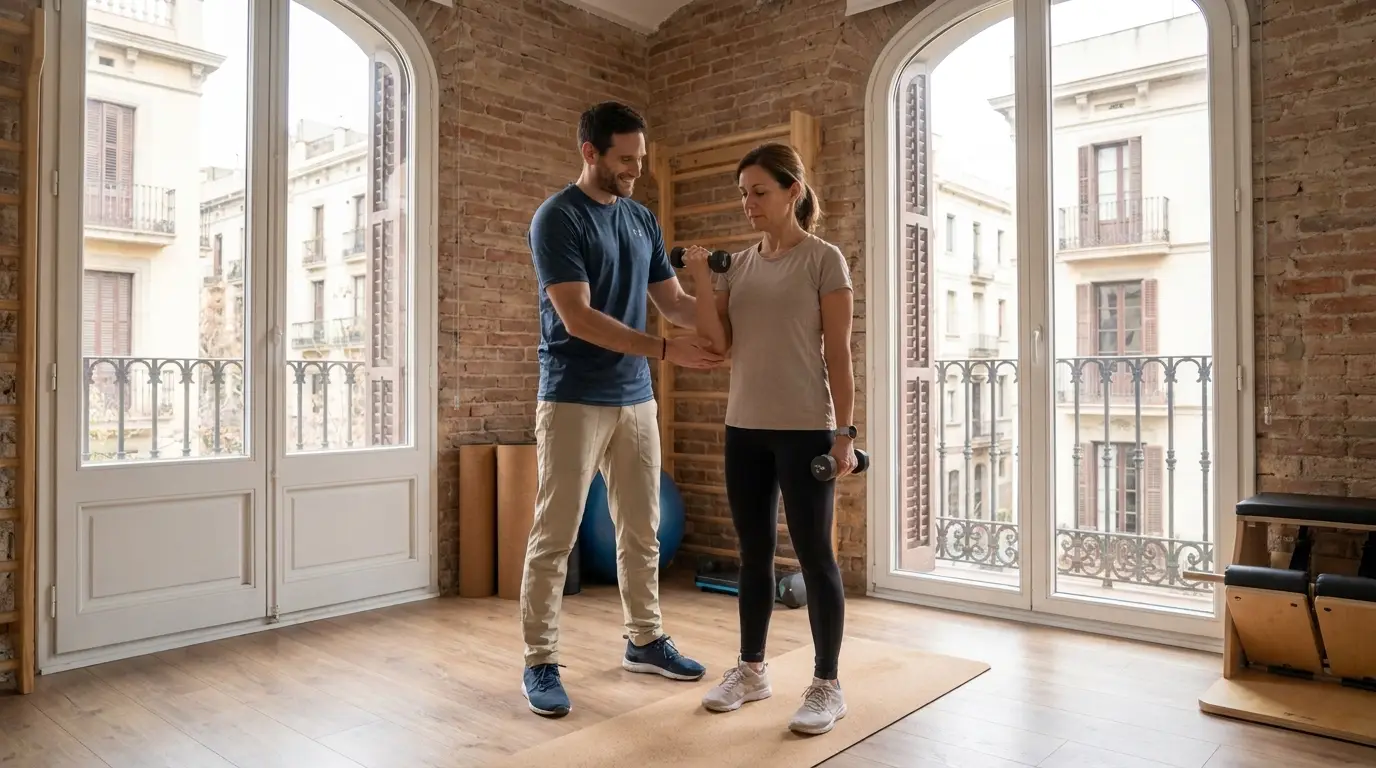
The featured image of this article was generated with AI.