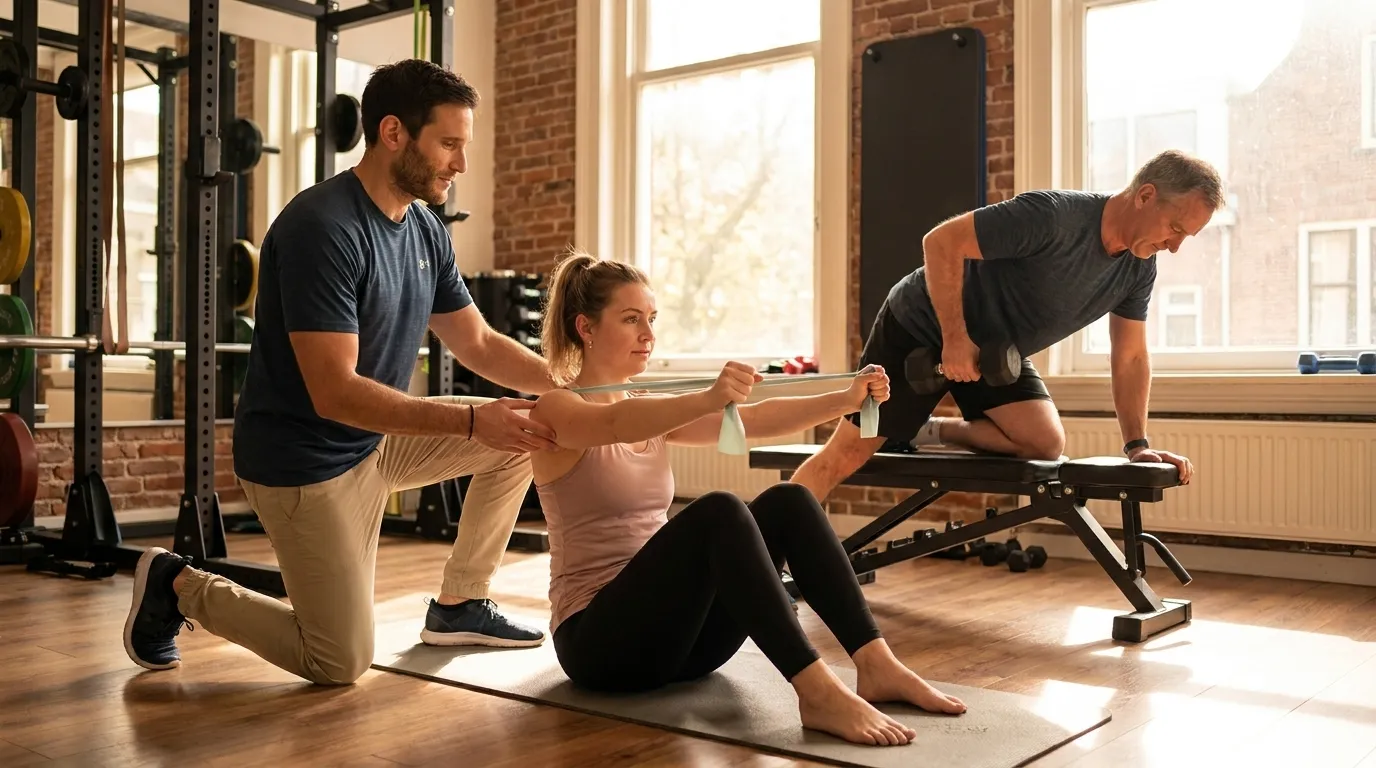
Starting strength training can feel intimidating — especially if you’re new to the gym, coming back after a break, or navigating a foreign city where everything from the equipment to the language feels unfamiliar. English-speaking expats in Barcelona say this all the time. The desire is there: get stronger, feel better, lower the risk of injury. What slows most people down is simply not knowing where to begin.
This guide is here to change that. Strength training for beginners doesn’t need to be extreme, painful, or complicated — and it works better when it isn’t. When done properly, it’s one of the safest and most effective investments you can make in your long-term health. In 2026, beginner strength training programs are more thoughtful and more personal than ever, with steady progress valued over quick fixes.
You’ll find clear guidance on how to start lifting weights safely, which exercises matter most, how often to train, and which common beginner mistakes quietly kill progress. There’s also specific context for expats and busy professionals in Barcelona, where work schedules, stress, and old injuries often shape how people train.
Why Strength Training Matters More Than Ever in 2026
Strength training still gets treated like a niche activity. That idea doesn’t hold up anymore. The American College of Sports Medicine (ACSM) ranks it as the top global fitness trend in 2026 — above cardio, HIIT, yoga, and everything else. You can see why in clinics, local gyms, and public health guidelines, not just weight rooms.
The evidence is overwhelming. Resistance training improves body composition, protects joints, increases bone density, boosts metabolism, and extends healthy lifespan. It works at 25 and it works at 65. And yet most adults still don’t meet basic strength guidelines — even when they know the benefits.
For beginners, the practical impact shows up fast. Daily movement feels easier: climbing stairs, carrying groceries, getting up from the floor without thinking. After 30, inactive adults can lose around 3–8% of muscle per decade. Starting now is always the right time.
How to Start Lifting Weights Safely
What matters most early on is moving at a steady pace so your body has time to adapt. Most beginner injuries happen for one of two reasons: weights increase too quickly, or form breaks down before it’s been properly learned. Copying advanced workout plans before mastering the basics is the third most common trap — it looks efficient but almost always leads to setbacks.
A good beginner program focuses on full-body movements. Squats, hip hinges, pushes, pulls, and core stability exercises build control and coordination that carry over to everything else. Machines are useful at the start because they guide movement and limit awkward positions. Free weights are valuable too — especially when someone walks you through setup and form so you’re not guessing.
Before adding weight, learn to execute these six fundamental movement patterns:
- Squat — knees over toes, chest up, neutral spine
- Hip hinge — deadlift pattern, hips back, flat back
- Horizontal push — bench press, push-up variations
- Horizontal pull — row variations
- Vertical push — overhead press
- Vertical pull — pull-up, lat pulldown
These six patterns cover virtually every major muscle group in the body. Master them, and you have the foundation for any program — beginner or advanced.
A few habits that make a real difference from day one:
- Train 2–3 times per week — where most beginners recover best
- Leave at least one full rest day between sessions
- End each set with 2–3 reps still left in the tank
- Move only through ranges that stay pain-free
Research shows that structured strength training reduces injury risk by roughly one third when volume increases gradually. That’s why many physiotherapists now use lifting as part of rehabilitation — not just prevention.
Beginner Strength Training Program: Full Week Example
The best beginner program is simple, repeatable, and easy to stick to. Complexity rarely leads to better results at the start. What works is showing up for each planned session — even on low-energy days — and doing the work. Four to six weeks with the same structure gives your body time to learn the movements and build a real foundation.
Day A & C (e.g. Monday and Friday)
| Exercise | Sets | Reps | Rest |
|---|---|---|---|
| Goblet squat or barbell back squat | 3 | 8–10 | 90 sec |
| Bench press or push-up variation | 3 | 8–10 | 90 sec |
| Romanian deadlift | 3 | 10–12 | 90 sec |
| Single-arm dumbbell row | 3 | 10–12 each | 90 sec |
| Plank | 3 | 30–45 sec | 60 sec |
Day B (e.g. Wednesday)
| Exercise | Sets | Reps | Rest |
|---|---|---|---|
| Bulgarian split squat or reverse lunge | 3 | 10 each | 90 sec |
| Dumbbell overhead press | 3 | 10–12 | 90 sec |
| Hip thrust | 3 | 12–15 | 90 sec |
| Lat pulldown or assisted pull-up | 3 | 8–10 | 90 sec |
| Bird-dog | 3 | 10 each | 60 sec |
Physiotherapist’s note: If you have a history of joint pain, a previous injury, or any recurring discomfort, don’t modify this program on your own. Get assessed first. Training through pain without guidance is how minor issues become serious ones.
Common Beginner Mistakes That Kill Progress
Most beginners run into the same early problems. Recognising them early makes a real difference.
- Training too hard, too soon — enthusiasm is good, but recovery needs to keep up. More sessions don’t equal faster results.
- Following advanced programs — bodybuilding splits designed for experienced lifters are not appropriate for beginners. They lead to confusion and burnout.
- Skipping the warm-up — five minutes of joint mobility and muscle activation work changes both performance and injury risk more than most people expect.
- Pushing through joint pain — delayed onset muscle soreness (DOMS) after training is normal. Sharp or persistent joint pain is not. Stop and get it assessed.
- Switching programs every week — consistency with one simple plan beats constantly chasing the “best” routine. Stick with the same structure for at least 4–6 weeks.
- Not tracking workouts — write down every set, rep, and weight. It takes 30 seconds and is the clearest signal of whether you’re progressing.
Fitness data consistently shows around half of new gym members quit within six months — usually due to low confidence or confusion, not lack of motivation. A clear beginner program lowers that risk significantly.
Strength Training Trends Shaping 2026
By 2026, beginner strength training looks quite different from a decade ago. The focus has shifted away from aesthetics alone and toward function, long-term health, and how the body holds up over time.
Wearables like the Oura Ring, Garmin, and Apple Watch are now common — used not to add pressure, but to track recovery signals like sleep quality and resting heart rate. Warm-ups increasingly include mobility and breathing work. Strength sessions blend in balance and coordination, often within the same set, and that’s intentional.
ACSM trend reports highlight programs that combine strength with mindfulness and core stability. Across Spain, functional training and hybrid coaching are growing fast. Beginners increasingly prefer in-person guidance during the week, with digital support filling the gaps during travel or busy periods. For trainers and physiotherapists, this means clearer communication and more consistent accountability.
Do You Need a Personal Trainer to Get Started?
You don’t need one — but having the right coach shortens the learning curve dramatically and removes most of the injury risk. A personal trainer with a physiotherapy background can:
- Assess your movement quality and identify compensation patterns before they cause problems
- Design a program matched to your actual goals, lifestyle, and current capacity
- Correct your technique in real time — which multiplies the value of every session
- Provide clear explanations in English, simple cues, and a calm, supportive space — especially important for expats navigating a new gym environment
When people feel safe and supported, they stay consistent. Showing up twice a week and building trust over time is what actually produces results — not the perfect program.
If you’re in Barcelona and want to start strength training with a solid foundation, I can help. My approach combines personalised training with physiotherapy-informed programming — built for results that last, without putting your body at risk.
→ Book your free assessment session
The Bottom Line
Strength training is the single best investment you can make in your long-term health. Starting well — with solid technique, intelligent progression, and a sustainable schedule — is the difference between results and injuries.
You don’t need to lift heavy. You don’t need to train every day. You need to start, stay consistent, and do it right. Strength training for beginners is about building habits that last — one session at a time.
Written by Felipe Barba — Certified Personal Trainer & Physiotherapist in Barcelona | personaltrainerbarcelona.com